Imaging
Cone-beam CT (CBCT)
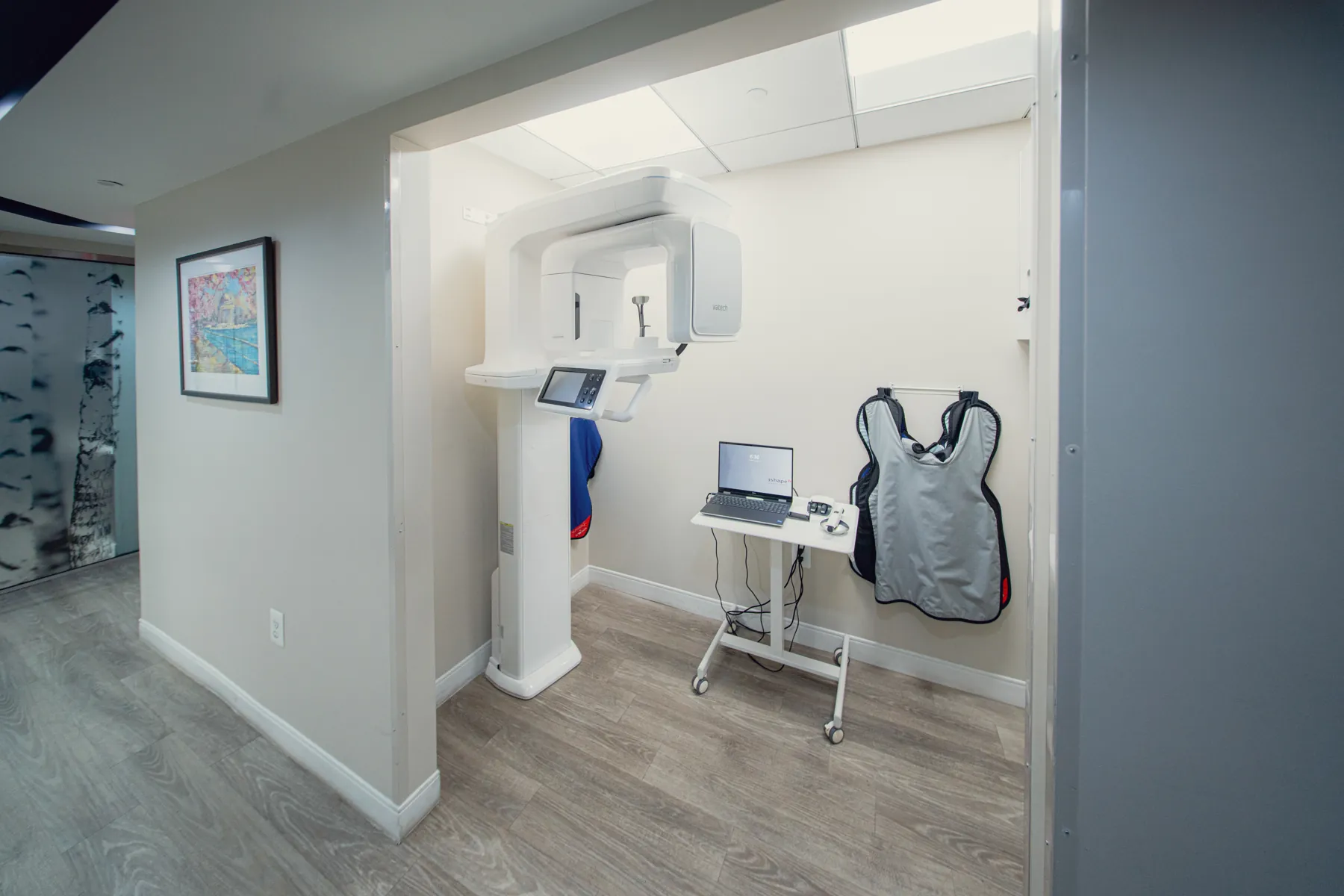
A specialty-grade three-dimensional scan of bone, sinuses, nerves, and tooth roots. We use CBCT before every implant case to confirm there is enough bone, identify anatomy that has to be avoided, and plan the exact angle and depth of placement before the surgery is scheduled — not on the day of.
Standard two-dimensional x-rays cannot show bone width, nerve canal position, or sinus floor with the precision implants require. CBCT is the difference between guessing and knowing.
Digital workflow
Intraoral scanning
We capture a complete digital model of the mouth in minutes — no impression trays, no gagging. The scan becomes the foundation for surgical planning, lab restorations, custom-fit guides, and apples-to-apples comparisons at every follow-up.
Digital scans transmit instantly to the lab, are stored as part of your record, and let us show you exactly what your bite looks like before and after treatment.
Guided surgery
3D-printed surgical guides
Implant placement planned on the digital model, fabricated as a physical guide that fits over the teeth, and used during surgery so the implant lands within fractions of a millimeter of the plan.
Guided surgery shortens chair time, reduces variability, and is the standard of care for full-arch and complex implant cases. It is the reason a case that used to take a full day takes a fraction of one.
Periodontal laser
LANAP laser therapy
Laser-Assisted New Attachment Procedure — an FDA-cleared protocol for treating periodontal disease without traditional cut-and-suture flap surgery. Where the diagnosis fits, recovery is faster and the patient experience is gentler.
Not every case is a LANAP case; we use it where the staging and tissue characteristics make it the right tool. Drs. Abron and Porzio are both LANAP-certified.
Regenerative grafting
S.M.A.R.T. minimally invasive bone grafting
A protocol for grafting bone and regenerating ridges through small incisions instead of large flaps. Faster healing, less swelling, and predictable outcomes for sites that need rebuilding before an implant can go in.
Dr. Abron trained on these techniques at the Frankfurt Master Clinician program (2022–2024) and uses them across implant and ridge-augmentation cases.
Sedation
IV sedation
Intravenous sedation administered by a periodontist trained and credentialed in its use — for patients who would rather not remember the procedure, or whose case is long or complex enough that sedation makes sense.
Drs. Abron and Porzio are IV-sedation certified. We discuss the full menu of comfort options (oral sedation, nitrous, IV) at consult and recommend what fits the case and the patient.